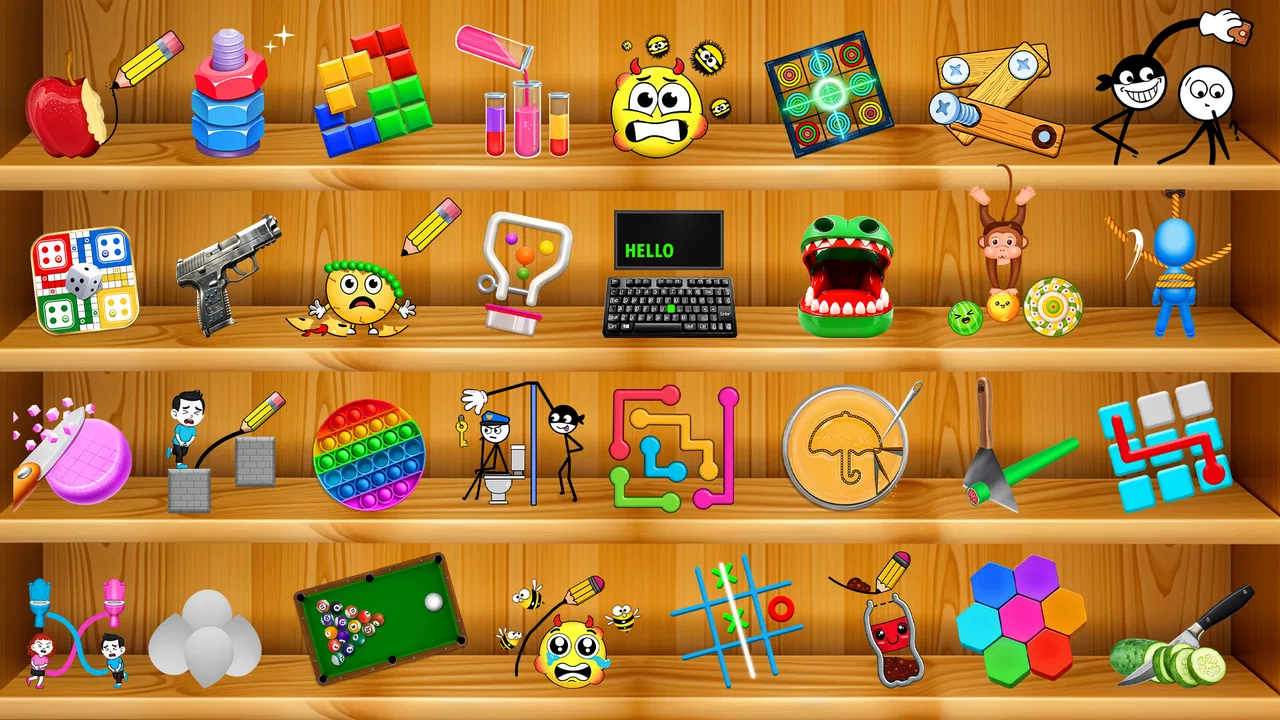
Mini Antistress Relaxing Games
- 4.2
- Rating
- 10.00M
- Installs
- Free
- Price
 Analysis by App-foxy
I opened Mini Antistress Relaxing Games expecting a quick distraction rather than a game I would keep returning to. That turned out to be the right way to approach it. This is a casual collection from stick hunter, built around short, calming activities instead of a single long campaign, competitive ladder, or demanding story. I found it most useful when I wanted something to occupy my hands for a few minutes without committing to a complicated game.
The appeal is simple: pick up the phone, choose a small activity, play at your own pace, and stop when your attention settles. The experience is aimed at relaxation and stress relief, but I would not treat it as a replacement for professional help or a guaranteed solution for anxiety. Its value is more modest and practical. It gives you a low-pressure pause, especially during the awkward gaps in an ordinary day when scrolling social media feels too noisy and a full game feels like too much work.
After spending time with it, my opinion is positive but qualified. The game is easy to approach, free to start, and broad enough to attract people who enjoy tiny tactile diversions. At the same time, its long-term appeal depends heavily on whether you genuinely like repeating simple activities. If you need deep strategy, a strong sense of progression, or a carefully structured challenge, this is probably not where I would send you.
You May Also Like

 Blood Strike: 2.5 Anniversary
Blood Strike’s Loadouts Turn Every Drop Into a Tactical Gamble
A close look at Blood Strike’s custom loadouts: how fast access to signature weapons reshapes its battle royale rhythm, rewards preparation, and narrows the gap between fights.

 Pandora - Music & Podcasts
Pandora’s Music Is Easy to Start, but Harder to Recover
Pandora’s strength is its low-effort path from a seed to a station. Its weak spot is how much confidence it asks you to place in connection, setup, and quiet recovery.

 8 Ball Pool
 Is Built on Rivalries, Rematches, and Routine
A close look at the rivalries, rematches, shared routines, and unanswered safety questions that turn a quick pool match into a persistent mobile community.

 Samsung Music
’s Quiet Strength Is Playing What You Already Own
Its reach comes less from spectacle than from dependable access to a personal library. That simplicity is both the app’s strongest retention engine and its ceiling.

 AccuWeather: Weather Radar
AccuWeather Review: A Quick, Clear Forecast for Everyday Decisions
For everyday plans, the best forecast is the one you can understand quickly. AccuWeather makes rain timing, radar, and local conditions easy to act on, with a few trade-offs.

 Hill Climb Racing
Why Hill Climb Racing Still Turns Crashes Into One More Run
A tiny car, a bumpy hill and one more upgrade: Hill Climb Racing keeps resurfacing because its simple chaos makes every near-miss feel personal.
More From Our News Desk



How I use it when I need a short reset
My most reliable routine is to decide on the length of the break before opening the game. I do not launch it with the vague intention of “playing for a while,” because that can turn a calming pause into aimless phone time. Instead, I start it during a transition: while waiting for an appointment, after finishing a difficult task, or before bed when I want something gentler than a competitive game.
The first useful habit is to choose an activity quickly rather than searching for a perfect one. The collection is designed for small moments, so I get more from it when I accept the first suitable option and begin. That keeps the game functioning as a reset tool instead of another decision-heavy app. If I am restless, I choose something with more direct interaction; if I am tired, I prefer an activity that lets me repeat a simple motion without much thought.
This makes the game particularly approachable for people who do not normally identify as gamers. There is no need to learn a complicated control scheme before getting started, and the casual format does not demand a long session. I could hand the phone to someone who only wants a few minutes of uncomplicated entertainment without explaining a story, character build, or objective hierarchy.
A realistic example is a crowded workday. After answering messages and switching between tasks, I might take a short break and use one of the mini-games instead of opening a news feed. The difference is that the activity gives my attention one small target. I am not trying to win a major contest or absorb more information; I am simply giving my mind a quieter task. That distinction is where the relaxing design makes sense.
Families may also find the format accessible, although the age label is Everyone 10+, so I would still use personal judgment when deciding whether it suits a younger child. The game is free to download, which makes trying it straightforward, but free access does not mean the entire experience is free from commercial considerations. Optional purchases range from $2.49 to $12.99 per item, so I would review the purchase controls before letting a child use the device.
What the collection does well in ordinary play
The strongest quality is low friction. I do not need to remember a complicated objective from a previous session, and I can leave after a brief interaction without feeling that I have abandoned a larger task. That is a better fit for stress relief than many mainstream casual games, which often use timed rounds, frequent rewards, or escalating challenges to keep me engaged.
Compared with a puzzle game, this collection is less demanding because it is not primarily asking me to solve a difficult problem. Compared with an endless runner, it is less energetic and less dependent on reflexes. Compared with a meditation app, it is more interactive and less structured. That middle position is useful: I can focus my hands and eyes without having to sit completely still or follow a spoken exercise.
There is also a practical advantage over simply watching short videos. A passive feed can leave me more scattered than before, while a small interactive task gives me a clear beginning and end. I still need self-control, but the activity itself is easier to contain. My advice is to treat it as a deliberate pause, not as an automatic response every time I feel bored.
Settings and phone habits worth checking first
I would begin by checking the device’s general notification and purchase settings rather than assuming a relaxing game will manage those choices for me. If I am using it before sleep, I also lower the phone’s brightness and enable the system’s preferred night display. Those changes are not special features of the game, but they make a real difference when the goal is to calm down rather than remain stimulated.
I also keep sound at a level that matches the situation. In a public place, I prefer silent or very quiet play so the session does not become socially awkward. At home, I may allow a little audio, but I avoid making it the center of the experience. The game works best for me when the interaction remains gentle and the phone does not demand attention through loud effects or frequent interruptions.
Because the title includes optional purchases, I recommend checking the platform’s purchase authentication before sharing the device. This is especially important for a family tablet or a phone used by children. The listed price range is easy to overlook when the initial download costs nothing, and a calming game should not create a stressful billing surprise.
Another useful setting is simply the phone’s built-in screen-time limit. I do not use the game as a reason to stay on the device indefinitely. A short limit turns the session into a repeatable habit: open it, settle into one activity, and leave when the break is over. Without that boundary, even a quiet casual game can become another source of procrastination.
The current version is 2.8, and the game requires Android 7.0 or later. That makes it suitable for a wide range of older Android devices, although the feel of the experience will still depend on the phone’s screen, responsiveness, and battery condition. I would not judge the game solely by how it performs on a very old handset, but I would make sure the device itself is comfortable for repeated touch interaction.
Repeatable patterns that make short sessions better
Experienced use is less about discovering a secret trick and more about removing unnecessary choices. I keep a mental shortlist of the activities that match three situations: a one-minute interruption, a longer decompression break, and a tired late-evening session. That prevents me from browsing aimlessly through the collection every time I open it.
For a very short break, I use one activity and stop immediately after it feels complete. The important part is not squeezing the maximum amount of play into the available time. It is creating a clean interruption between two parts of the day. If I have more time, I may switch activities once, but I avoid jumping constantly because that turns the session into sampling rather than relaxing.
A second pattern is to use the game after an intense task, not before one that requires concentration. If I play it immediately before studying or writing, I may find the transition back to serious work less direct. After a demanding task, however, the simple interaction helps me mark the end of that effort. This is a small trade-off, but it changes whether the game supports my routine or disrupts it.
I also recommend keeping expectations modest. The collection cannot manufacture calm if I am checking messages, worrying about an urgent problem, and switching between apps at the same time. I get the best result when I put the phone on a stable surface, focus on the selected activity, and allow the session to remain uneventful. The absence of excitement is a feature here, not a defect.
One non-obvious benefit is that the format can work as a transition for people who dislike formal mindfulness exercises. Some users find guided breathing or silent meditation uncomfortable because they become too aware of their thoughts. A small interactive game offers an external focus without demanding a particular emotional response. It is not mindfulness training, but it can be a more approachable first step toward taking a deliberate pause.
Where the relaxing formula reaches its limits
The same simplicity that makes the game accessible can make it feel repetitive. If I am looking for a sense of growth, increasingly difficult stages, or a reason to master a particular system, the collection may lose its appeal after the novelty fades. Its purpose is closer to a pocket of low-pressure activity than to a long-term progression game.
It is also not ideal for every kind of stress. When I need to solve a concrete problem, playing can become avoidance rather than recovery. If I am anxious because I have an important message to send or a deadline approaching, a mini-game may give me temporary relief while leaving the actual source of tension untouched. I would use it to create enough space to act, not to postpone action indefinitely.
People who are sensitive to repetitive touch tasks may also find that the collection becomes irritating instead of soothing. Relaxation is personal. Some players will enjoy the simple feedback, while others will prefer music, reading, walking, or a structured breathing exercise. I would give the game a fair trial, but I would not force it into a routine if the interaction starts feeling mechanical.
The commercial model is another limitation to keep in mind. The download is free, but optional items cost between $2.49 and $12.99. That does not automatically make the game poor value, yet it means I would avoid assuming that every part of the experience is available without spending. For someone specifically searching for a completely purchase-free relaxation tool, a basic offline activity or a free meditation resource may be a better match.
There is also a difference between casual accessibility and universal comfort. A touch-based game can be tiring for someone with hand pain, limited dexterity, or difficulty using a small screen. In that case, an audio-first app or a physical relaxation method could be more suitable. The game’s light design does not remove the need to consider how the device feels in the user’s hand.
Who should try it, and who should choose something else
I would recommend it to someone who wants a collection of tiny diversions, dislikes competitive pressure, and prefers doing something with their hands rather than watching content passively. It is especially appealing if your day contains many short waiting periods and you want a consistent way to fill them without starting a large game.
It is also a reasonable choice for casual players who do not want to learn complex rules. The category is clearly casual, and the design is approachable enough for a quick trial. With over 10 million installs and an average rating of 4.3 from around 131 thousand ratings, it has attracted a substantial audience, although popularity alone does not guarantee that its calm, repetitive style will suit everyone.
I would point a different way for players who want narrative, competitive multiplayer, deep puzzles, or a strong achievement system. A dedicated puzzle title will usually provide more satisfying problem-solving, while a meditation app will offer more structured guidance. A physical walk may be better when the main problem is mental overload caused by too much screen time. This game sits between those options rather than replacing them.
The developer, stick hunter, has positioned the release as a casual antistress game, and that description matches my experience better than calling it a conventional arcade title. I would not download it expecting a dramatic challenge. I would download it because I want a small, repeatable activity that asks little from me and can end whenever I choose.
My verdict after making it part of a routine
Mini Antistress Relaxing Games works when I use it with a clear purpose. The best approach is to choose one short activity, reduce distractions, keep purchase controls in mind, and stop before the break turns into another long phone session. That workflow makes the collection feel more intentional and gives its calming design a fair chance to help.
Its weaknesses are equally clear. Repetition may limit long-term interest, the free model includes optional purchases, and the game cannot address the underlying cause of serious anxiety or stress. It is also not the right tool for someone who needs challenge, progression, or rich content. I appreciate that the experience does not pretend to be more ambitious than it is.
For me, the final judgment is that this is a useful pocket companion rather than a game I would play for hours. Its value comes from the gap between a passive scroll and a demanding game: a few minutes of simple interaction, enough focus to interrupt a tense moment, and no obligation to continue. The smartest way to use it is as a bounded reset, not as an endless escape.
If that sounds like the kind of break you actually need, the free download makes trying it low-risk. Just remember that the title is best judged by how it fits your personal routine, not by how many mini-games you can get through. When used deliberately, it is a pleasant casual option for quiet pauses; when used without limits, it can become just another reason to keep looking at the phone.
FAQs for Mini Antistress Relaxing Games
01What are Mini Antistress Relaxing Games?
Mini Antistress Relaxing Games is an app designed to help users unwind and relieve stress through a variety of simple, engaging mini-games. These games focus on calming activities like painting, drawing, or interacting with soothing environments. The app aims to provide a quick escape from daily stressors by offering an array of tranquil experiences.
02Is Mini Antistress Relaxing Games free to download?
Yes, Mini Antistress Relaxing Games is free to download on both Android and iOS platforms. While the basic features are accessible without any cost, the app may offer in-app purchases or premium content that can enhance the user experience. It's advisable to check the app store for specific details on any costs involved.
03Do these games require an internet connection?
No, most of the games in Mini Antistress Relaxing Games can be played offline, making it a convenient option for users who want to relax without needing an internet connection. However, certain features or updates might require internet access, so it's recommended to occasionally connect to enjoy the full range of features.
04Are there any age restrictions for playing Mini Antistress Relaxing Games?
Mini Antistress Relaxing Games is generally suitable for all ages, as it focuses on stress relief through simple and calming activities. However, it's always a good idea for parents to review the content to ensure it aligns with their expectations for younger users. The app store listing will also provide guidance on age suitability.
05Can Mini Antistress Relaxing Games actually help reduce stress?
While individual results may vary, Mini Antistress Relaxing Games is designed with relaxation in mind. The calming activities and ambient sounds aim to create a soothing environment that can help users feel more at ease. Many users find that taking a break to play these games can provide a mental reset and contribute to overall stress reduction.
Pros
- Wide variety of mini-games for all ages.
- Simple and intuitive user interface.
- Offline play available for convenience.
- Regular updates with new content.
- High-quality graphics and sound effects.
Cons
- Contains ads that can be intrusive.
- Some games require in-app purchases.
- Limited customization options.
- Occasional performance lags.
- Not all mini-games are equally engaging.

Mini Antistress Relaxing Games
Gallery